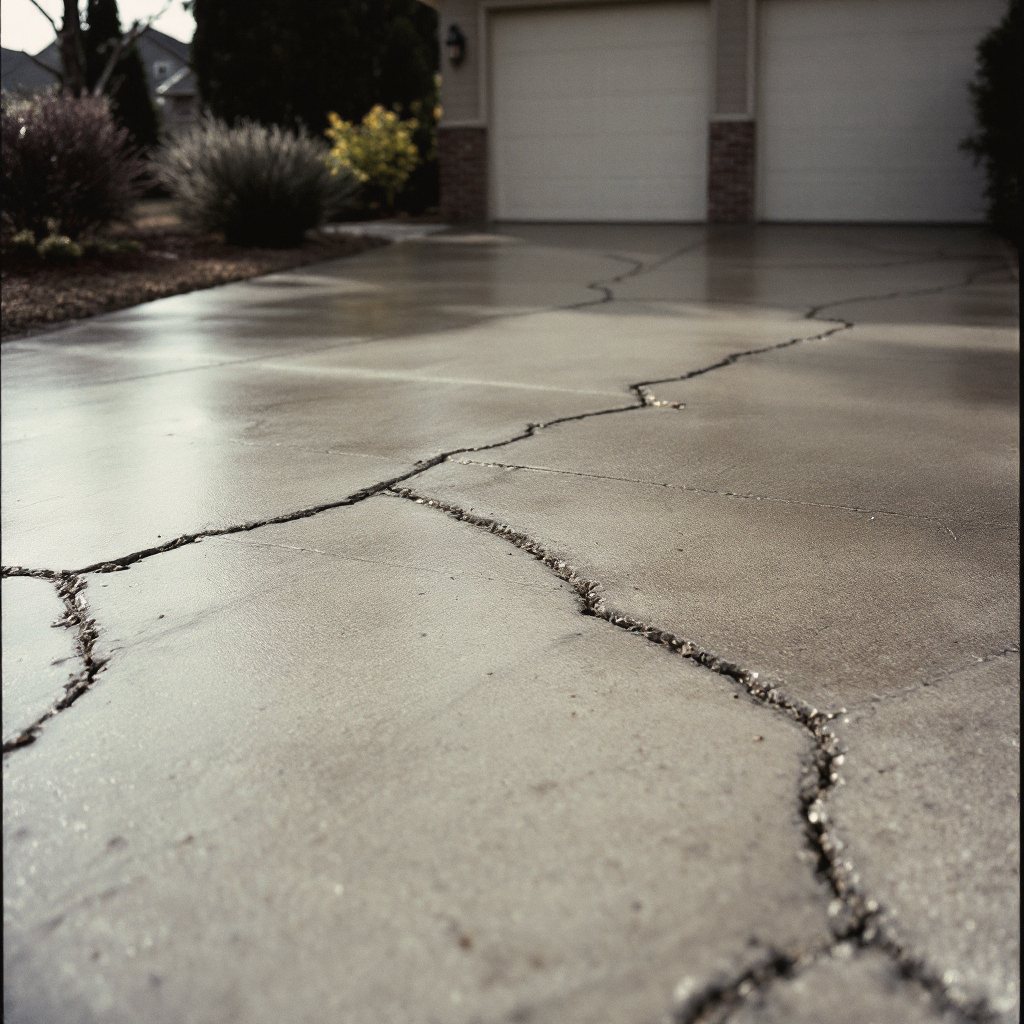
Why are so many Fishers driveways failing at the same time?
Drive any 1990s or early-2000s Fishers subdivision and you'll see the same thing: scaling surfaces, map cracking, panels heaved at the garage apron. It's not coincidence — those driveways were poured in a building boom, often with marginal air content, joints cut late and no cure, and central Indiana's freeze-thaw cycle has spent twenty winters collecting the debt. The salt tracked off the roads finishes the job.
The fix isn't pouring the same driveway again. It's pouring one specified for this climate: 4,000 PSI air-entrained mix (the entrained air gives freezing water somewhere to expand without breaking the surface), a compacted stone base, joints sawed on time at the right spacing, and a cure compound applied the day of the pour. Every one of those lines shows up in our quote so you can see what you're buying.
Joints on a plan — cracks go where we tell them to.
What does a concrete driveway cost in Fishers?
Full replacement typically runs $8–$14 per square foot installed. A standard 800 sq ft two-car driveway lands roughly $6,500–$11,000 depending on tear-out and haul-off, thickness (4" standard, 5–6" where trucks park), reinforcement, finish, and access. Decorative borders or exposed aggregate add from there. Beware of bids that come in dramatically under that range — the money usually comes out of base depth, air content or cure, which is exactly where the slab fails.
What actually determines whether a driveway lasts?
The base. Compacted stone over inspected subgrade. Settlement cracks are base failures, not concrete failures.
Air entrainment. Non-negotiable in a freeze-thaw climate. It's invisible on pour day and everything by winter three.
Joint timing and spacing. Concrete cracks; joints decide where. Sawed too late or spaced too far, the slab picks its own pattern.
The cure. Concrete reaches strength by hydration, not drying. Cure compound the same day, and no deicing salt the first winter.
Thickness to the load. 4 inches for cars, more where the truck, boat or RV lives.
Tear-out to pour is usually 2–3 working days, weather permitting. You can walk it at 24–48 hours and park on it after 7 days.
Can you pour over my existing driveway?
Overlays over failed slabs inherit the failure. If the existing drive is cracked or settled, tear-out and a proper base is the honest answer — we will tell you if an overlay legitimately fits your case.
Do I need rebar or wire mesh?
Reinforcement helps hold cracks tight but does not replace a good base. We spec fiber, mesh or rebar to the situation and itemize it, so you are not paying for steel that does nothing.
What finish options are there?
Broom finish is the standard for traction. Exposed aggregate and stamped or colored borders dress it up — see the stamped and decorative page for the full range.
Will the new driveway match my sidewalk color?
New concrete cures lighter and darkens slightly with age; exact matching to 20-year-old flatwork is not realistic and anyone promising it is guessing. It blends substantially within a year.