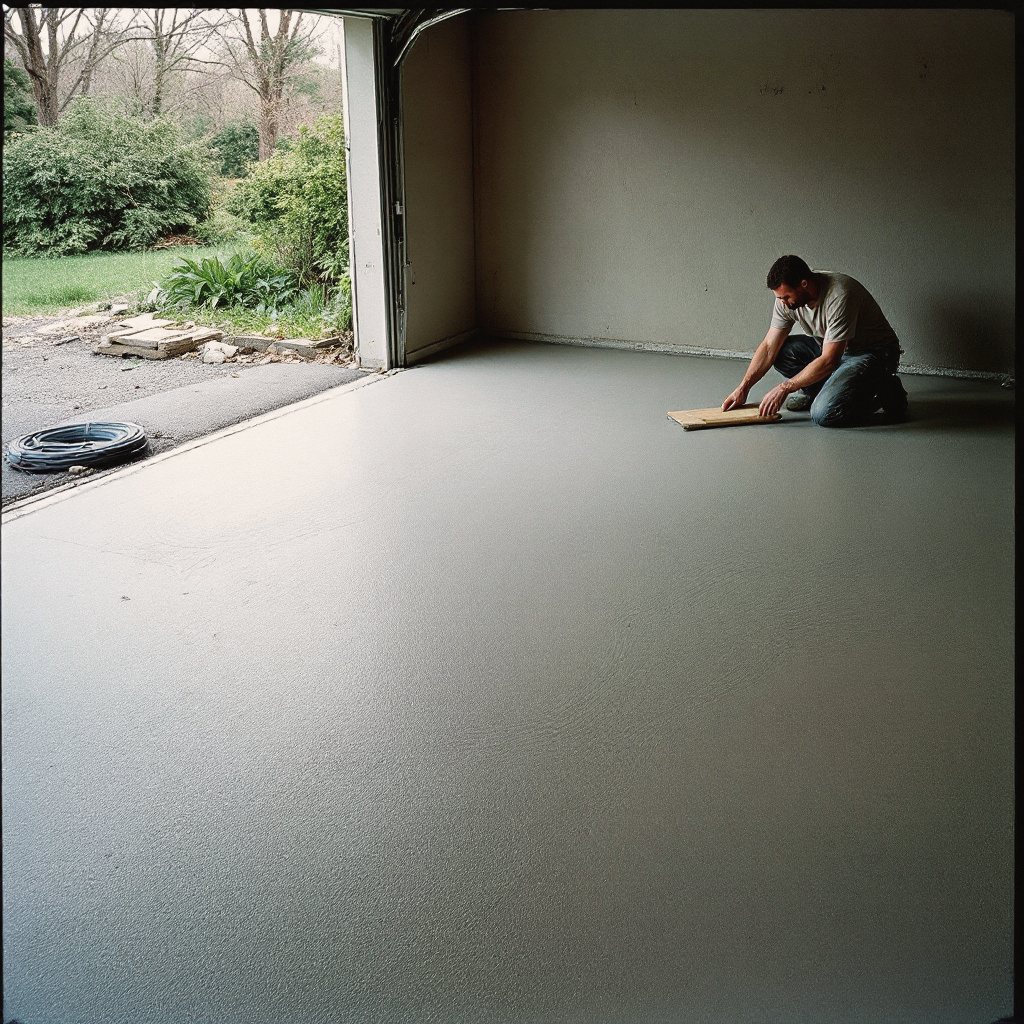
What makes an interior slab different from a driveway?
Weather stops mattering and moisture starts. An interior slab lives under finished space, storage or a vehicle lift, so the specification shifts: a vapor barrier under the pour (skip it and years later the epoxy peels and the LVP cups), flatness tolerances that matter when cabinets and cars sit on it, and a steel-trowel finish instead of broom. Garage slabs also want proper thickness at the load — 4 inches standard, more under lifts and heavy equipment — pitched subtly to the door so melt-off leaves.
Steel-trowel finish: the slab that is ready for epoxy, tile or polish.
Garage slab replacement — what does it involve?
More Fishers garages need this than owners expect: the original slab was often poured on poor fill and has settled or cracked through. Replacement means breaking out the old slab inside the existing foundation walls, correcting and compacting the base, new vapor barrier, and a reinforced pour finished smooth. Typical two-car garage: $5,500–$9,500, most of the range explained by tear-out condition and access. Two to three days of work; park elsewhere for a week after.
Basement and pole barn floors
Basement slab sections — bathroom rough-in trenching, sump routes, settled-section replacement, or full pours in older homes with rat slabs. We coordinate with your plumber's rough-in so the trench is cut, plumbed and poured back once.
Pole barn floors — the east-flank classic. Big open pours, thickened where the tractor or hoist lives, cut into proper joint panels. Priced by the slab, not the square-foot myth: access and thickness rule the number.
4 inches for daily drivers, 5–6 inches under lifts, trailers or equipment — thickened at point loads. Thickness costs little at pour time and everything to add later.
Do I need a vapor barrier under an interior slab?
Yes, full stop. Ground moisture migrates through concrete forever without one, and every floor covering you ever install pays for it.
When can I epoxy or coat a new slab?
Concrete needs to release its mix water first — typically 30–60 days depending on conditions before coating. We give you the date and a moisture-test method, not a guess.
Can you pour a slab for a garden shed or hot tub?
Yes — small pads are quick wins. Hot tubs want a level, reinforced pad rated for the filled weight; we spec to the tub's documented load.
My garage floor slopes toward the house — can that be fixed?
That is a replacement conversation, not a patch: the slab settled. New base, correct pitch to the door, and the melt-off problem ends.